

Sharing a wardrobe sounds simple.
Until it isn’t.
At first, it’s just a few shirts placed in the wrong section. A pair of shoes pushed into someone else’s corner. A hanger that disappears. Then slowly, tension builds.
You may not argue about the closet directly. But you feel it.
I’ve worked with many couples trying to manage small living spaces. One pattern shows up again and again: storage problems are rarely about space. They are about boundaries.
After years of testing different approaches in real homes, I developed a simple method that works consistently. I call it the Clear Boundary Zones (CBZ) System.
This system is not about making your closet look perfect for Instagram. It is about making it peaceful, fair, and easy to maintain.
Let me walk you through it.
Why Shared Wardrobes Cause So Many Arguments?
Before fixing the problem, we need to understand it.
Here are the most common reasons couples fight over closet space:
1. No Clear Ownership
When sections are not clearly divided, small boundary crossings feel bigger than they are.
Even if no one says it out loud, we all want a space that feels like ours.
2. Unequal Space
One partner may have more clothes. Or maybe their items are bulkier. But when space feels unfair, resentment grows.
3. Emotional Attachments
Clothes are not just clothes. They represent memories, identity, milestones.
Throwing away or relocating an item can feel personal.
4. Clutter Creates Stress
Research in environmental psychology shows that cluttered spaces increase stress levels. When your closet feels chaotic first thing in the morning, it affects your mood for the day.
Studies published in journals like Current Directions in Psychological Science show that small daily stressors can slowly affect relationship satisfaction.
The closet becomes one of those daily stress triggers.
The good news? Structure reduces stress.

The Clear Boundary Zones (CBZ) System:
The CBZ system is built on three simple ideas:
1. Clear ownership reduces conflict.
2. Organized zones reduce daily frustration.
3. Regular check-ins prevent future arguments.
That’s it.
No complicated psychology. No extreme minimalism. Just structure.
Step 1: Do a Space Reality Check
Before reorganizing anything, measure what you actually have.
Take 10–15 minutes to measure:
Hanging rod length;
Number of shelves;
Drawer space;
Floor storage;
Then write it down.
Create a simple table like this:
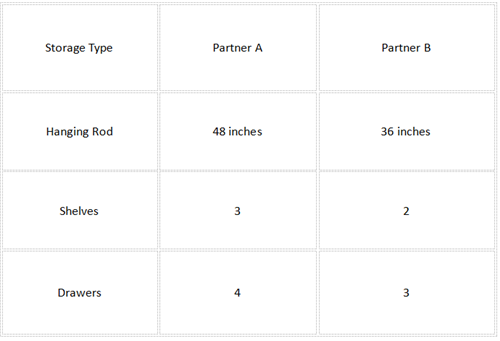
You might discover something surprising.
In many homes I’ve worked with, the partner who felt shortchanged actually had equal or even more space. The issue was not math—it was perception.
Seeing real numbers makes the conversation calmer and more logical.
Step 2: Track What You Actually Wear
For two weeks, notice what you wear.
You don’t need an app. Just mentally observe:
What gets worn often;
What hasn’t been touched in months;
What is “just in case”;
Most people wear 20–30% of their wardrobe regularly.
When couples realize how many unused items are taking prime space, decisions become easier.
Move rarely worn items out of daily reach.
Instant breathing room.
Step 3: Create Three Clear Zones
This is the heart of the CBZ system.
Instead of mixing everything together, divide the closet into three zones.
Zone 1: Daily Zone
This is eye-level, easy-reach space.
It should contain:
Work clothes;
Frequently worn outfits;
Current season essentials;
Each partner has clearly marked boundaries.
No overlap.
No mixing.
Physical separation reduces invisible tension.
Zone 2: Rotation Zone
This holds:
Special occasion outfits;
Travel clothing;
Backup items;
Off-season pieces;
Store these slightly higher or in labeled bins.
They are accessible—but not competing with daily items.
Zone 3: Archive Zone
This is for:
Sentimental items;
Rare formalwear;
Memory-linked clothing;
Use labeled containers or high shelves.
Separating emotional clothing from daily clothing reduces decision fatigue.
You are not forcing anyone to throw anything away. You are just organizing by function.

Step 4: Use Vertical Space Wisely
If your closet is small, go vertical.
Install:
Double hanging rods;
Shelf dividers;
Clear stackable bins;
Drawer organizers;
Over-the-door hooks;
Vertical solutions can increase usable space by 30–40% in small apartments.
But remember: adding storage without structure will not solve arguments.
Structure comes first. Tools come second.
Step 5: Rotate by Season
Seasonal rotation prevents overcrowding.
Every three months:
1. Remove off-season items from Zone 1;
2. Move them to Zone 2 or storage bins;
3. Bring current-season items forward;
The National Association of Productivity and Organizing Professionals reports that shared storage is one of the most common household conflict areas.
Regular rotation prevents buildup.
Think of it as a reset button.
Step 6: Agree on a “New Items” Rule
Many closet arguments begin after shopping.
Create a simple agreement:
One-in, one-out rule for daily items;
Each partner gets one overflow bin;
Large purchases require a conversation;
This keeps space stable.
When boundaries are agreed on in advance, conflict drops dramatically.
Step 7: Handle Sentimental Items With Care
Never force emotional decisions during an argument.
Instead:
Create a memory box;
Take photos of meaningful clothing;
Set a limit for archive space;
Respect matters more than minimalism.
Studies published in Journal of Social and Personal Relationships show that collaborative decision-making increases relationship satisfaction.
The closet becomes a teamwork exercise—not a power struggle.
Step 8: Schedule Short Maintenance Check-Ins
Systems fail when they are ignored.
Add three small rituals:
Monthly (10 Minutes)
Return misplaced items
Check zone boundaries
Quarterly (30 Minutes)
Rotate seasonal clothes
Remove unused items
Yearly (1 Hour)
Re-measure space
Adjust if lifestyles changed
Small maintenance prevents big arguments.
Step 9: Use Simple Conflict Rules
Even with structure, disagreements happen.
When they do:
1. Pause.
2. Identify the issue (Was a boundary crossed?)
3. Refer back to your agreed system.
4. Fix the structure—not blame the person.
This keeps discussions calm and focused.
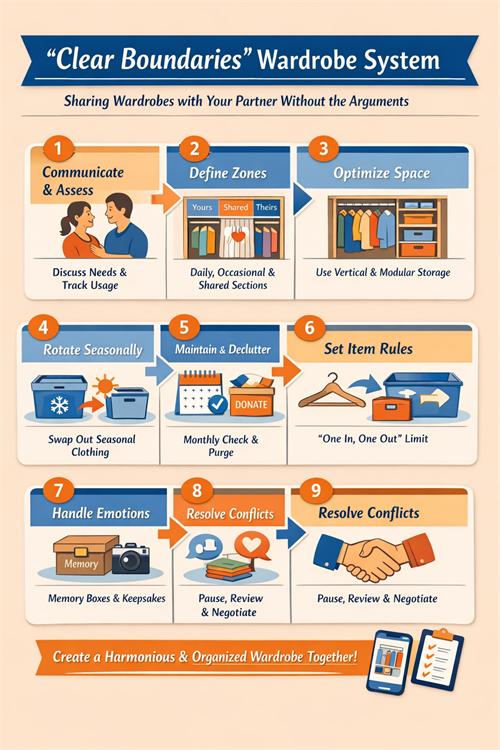
What Changes After Implementing CBZ?
Couples who consistently use this system report:
Less morning stress
Faster outfit selection
Fewer “Where is my…” moments
Reduced tension around shopping
More balanced feelings about space
In many homes, the biggest change is emotional.
The closet stops feeling like a shared battlefield.
It becomes neutral ground.
Common Mistakes to Avoid:
Organizing without discussing expectations;
Focusing only on aesthetics;
Ignoring emotional items;
Skipping maintenance;
Allowing one partner to slowly expand into the other’s zone;
Clear lines prevent silent resentment.
Small Closet? No Problem.
If you live in a small apartment:
Use under-bed storage;
Install ceiling-height shelves;
Store suitcases with off-season items inside;
Use slim hangers to increase rod capacity;
Even tiny closets can function peacefully with clear boundaries.
Space size is rarely the real issue.
Structure is.
Bigger Picture: Why This Matters
A wardrobe is a daily-use environment.
You interact with it every morning and every night.
When that space feels chaotic or unfair, it affects your mood.
When it feels calm and predictable, it reduces mental load.
Small systems influence big feelings.
The closet becomes a training ground for communication, fairness, and cooperation.
Final Thoughts
Sharing a wardrobe does not have to lead to arguments.
You don’t need perfection.
You need clarity.
The Clear Boundary Zones system works because it:
Defines ownership
Organizes by function
Separates emotion from daily use
Controls growth
Requires simple maintenance
When boundaries are clear, relationships feel safer.
And when systems are fair, tension fades.
Start small.
Measure.
Divide.
Rotate.
Maintain.
Peaceful closets are built—not wished for.
References:
[1]Evans, G. W., & McCoy, J. M. (2021). Environmental psychology and organized living spaces.
[2]Finkel, E. J., Hui, C. M., Carswell, K. L., & Larson, G. M. (2017). Published in Current Directions in Psychological Science.
[3]Caughlin, J. P., & Huston, T. L. (2020). Published in Journal of Social and Personal Relationships.
National Association of Productivity and Organizing Professionals (2022). Shared space survey.
Author Information:
Dr. Lauren Mitchell, PhD, is an American behavioral science specialist focused on practical household systems and shared living environments. Her work centers on helping adults design simple, sustainable systems that reduce daily stress and improve cooperation at home.
She combines research insight with real-world application to create clear, workable frameworks that support both organization and relationship stability.
Disclaimer:
This article is for educational purposes only. It is not professional counseling or mental health advice. Results vary depending on individual situations. Readers are responsible for applying strategies appropriately and seeking qualified professionals when needed.
Recommend:

The 1+3 Drink Rule: How I Host Gatherings Without Bartending

Stop Dreading Seasonal Cleaning: My Zone System That Cuts Fatigue by 50%

Sharing Wardrobes Without Arguments: How We Built Our “Clear Boundary Zones” System That Actually Works

Improving Cooking Efficiency: 3 Kitchen Tools I Invested In and Their Ultimate Usage