

Five years ago, I bought an expensive home coffee machine. The logic seemed flawless:
“If I drink café coffee daily, this machine will pay for itself within a year.”
Six months later, it sat unused in my kitchen—not because it was low quality, but because it demanded ten extra minutes every morning.
That moment forced me to confront a deeper question: what kind of “upgrade” actually improves life — and what quietly becomes clutter?
Around the same time, a broader shift was happening globally. The idea of consumption reduction was gaining attention — not as forced austerity, but as a voluntary move toward value-focused spending.
Across many economies, rising uncertainty, income instability, and price fluctuations were reshaping household priorities. Data from the World Bank shows that households are increasingly shifting from symbolic consumption toward functional spending under uncertainty [1].
This wasn’t pessimism. It was maturity. People weren’t abandoning quality — they were redefining it. And so did I.
Part 1: Understanding the Era of Rational Consumption
Consumption reduction today does not mean living worse. It means:
Paying less for status;
Paying more for usefulness;
Spending intentionally;
Research from the OECD shows that modern households are reallocating spending toward health, safety, and essential life infrastructure, while reducing discretionary prestige consumption [2].
In daily life, this looks like:
Choosing fabric quality over brand labels;
Cooking nutritious meals instead of pursuing dining prestige;
Buying second-hand when function remains intact;
Globally, the rise of:
Shared mobility;
Rental models;
Second-hand marketplaces;
reflects a structural shift toward cost-effectiveness without lifestyle decline.
In my own home, this translated into a working principle: upgrading and downgrading are not opposites — they are simultaneous decisions.
True upgrading = better long-term value per dollar
True downgrading = removing premiums that serve no real need

Part 2: My Core Rule—Upgrade Function, Downgrade Symbolism
Instead of asking:
“Is this expensive or cheap?”
I now ask:
“Does this improve daily life?”
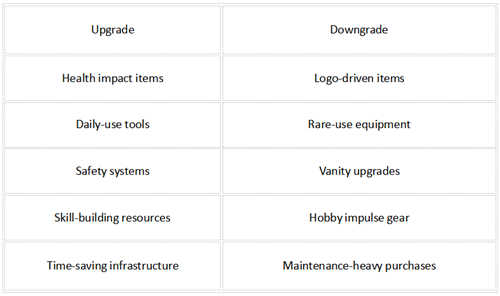
This rule came directly from lived failures — like the coffee machine.
Part 3: My “Resolute Upgrade” List
3.1 Daily Physical Contact Items
Anything touching my body for hours each day now qualifies as an upgrade priority:
Mattress;
Shoes;
Office chair;
Pillow;
After replacing a low-cost mattress with a mid-range latex model, my sleep quality improved dramatically. The cost per night became negligible — while daily wellbeing improved. Similarly, upgrading footwear reduced fatigue during long walking days.
Lesson: If it affects your body daily, quality matters.
3.2 Skill-Building Tools
Tools only create value when paired with skill. Otherwise, they become “productive-looking clutter.” For example, investing in an online home organization workshop transformed how I structured storage — reducing item search time by 70%.
3.3 Safety Infrastructure
Even rarely used safety devices are crucial. I upgraded:
Smoke alarms;
Locks;
Basic emergency devices;
The World Health Organization emphasizes preventive household safety as cost-effective long-term risk reduction [3].
3.4 Frequently Used Kitchen Tools
Mid-range daily kitchen tools improved efficiency. Better knives alone cut meal prep time by nearly one-third — not luxury, just functional efficiency.
3.5 Preventive Health Investments
Upgrades included:
Air filtration;
Sleep systems;
Routine screenings;
Preventive spending aligns with Maslow’s foundational needs — prioritizing stability over status.

Part 4: My Strategic Downgrade List
4.1 Logo-Driven Consumption
Premium wallets or branded goods often wore out faster than simple handmade alternatives. Now, I prioritize:
Materials;
Durability;
Craftsmanship;
Global consumer research shows declining reliance on status signaling as economic uncertainty rises [4].
4.2 Subscription Overload
Households often maintain multiple streaming subscriptions without proportional use. Reducing subscriptions lowered costs while maintaining satisfaction.
4.3 Hobby Impulse Purchases
Experience first (rent/borrow), purchase later. Camping equipment or hobby gear is only purchased after genuine use.
4.4 Daily Micro-Spending
Takeaway coffee was a major invisible expense. Reducing frequency — not eliminating it — cut monthly spending by 75% without diminishing enjoyment. Behavioral studies indicate stress often fuels habitual small purchases [5].
4.5 Brand Bulk Buying
Bulk is only rational when:
Consumption is predictable;
Storage is efficient;
Otherwise, savings turn into waste.
Part 5: The Rise of Shared & Second-Hand Consumption
Ownership is no longer required for utility. I embraced:
Rental tools;
Shared mobility;
Second-hand electronics;
These provide full function, lower cost, and reduced storage burden — aligning with sustainability goals and reducing lifecycle waste.
Part 6: The Three Questions That Guide Every Purchase
Before buying anything, I ask:
How often will this be used?
Daily → Upgrade
Occasional → Consider downgrade or rental
What problem does it solve?
Emotional satisfaction fades quickly; functional relief lasts.
Am I willing to maintain it?
Hidden time costs include cleaning, storing, and repairing. If not, I don’t buy it.
Part 7: Household Impact After 18 Months
Applying this system produced measurable results:
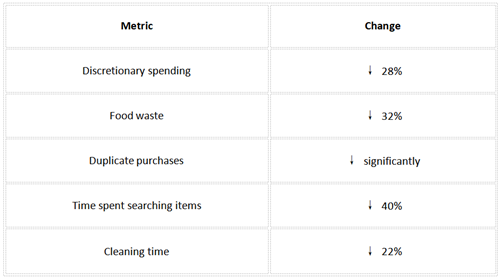
More importantly, household stress decreased, and decision-making became clearer.
Part 8: The Ultimate Benefit—Control
Rational consumption builds:
Financial buffer;
Decision clarity;
Environmental sustainability;
The biggest personal gain was psychological: owning fewer low-value items increased freedom. Research shows households shift from preference-driven to value-driven decisions under constrained resources — a positive trade-off, not deprivation [6].
Part 9: Your Starter Upgrade & Downgrade List
Upgrade First:
Sleep systems;
Food storage;
Safety tools;
Daily-use equipment;
Skill-building resources;
Downgrade First:
Logo-based goods;
Unused subscriptions;
Hobby gear;
Decorative clutter;
Habitual convenience spending;
Conclusion: Rational consumption is not about spending less — it is about ensuring every dollar serves the life you actually live. When upgrading and downgrading work together, households gain:
Stability;
Space;
Time;
Freedom;
And that is the true upgrade.
References:
[1] World Bank. (2023). Global Consumption Trends Report. https://www.worldbank.org
[2] Organisation for Economic Co-operation and Development (OECD). (2023). Household Financial Resilience Study. https://www.oecd.org
[3] World Health Organization (WHO). (2022). Household Safety & Prevention Report. https://www.who.int
[4] Journal of Consumer Behaviour. (2024). Value-Based Consumption Study. https://onlinelibrary.wiley.com
[5] American Psychological Association. (2022). Stress and Spending Behavior. https://www.apa.org
[6] United Nations Environment Programme (UNEP). (2021). Sustainable Consumption & Household Impact. https://www.unep.org
Author Information:
Jennifer Morrison is an independent researcher and writer specializing in family finance, personal consumption, and practical lifestyle management. She holds a master’s degree in economics and has over 12 years of experience in personal finance management.
Jennifer previously worked as a policy analyst at a California consumer rights organization before founding the personal finance blog The Thoughtful Spender, translating behavioral economics research into actionable guidance for adults managing modern households.
She is a certified financial advisor through the American Consumer Interest Association (ACCI) and has contributed columns to Forbes. Jennifer focuses on helping families make intentional, sustainable consumption choices that increase financial stability, reduce stress, and improve quality of life.
She currently lives with her family in Portland, USA, and actively applies her consumption strategies daily.
Disclaimer
This article is for educational purposes only and does not constitute financial, medical, or psychological advice. Readers should adapt consumption strategies to individual circumstances, financial realities, and cultural contexts.
Before making significant lifestyle or financial changes, consult qualified professionals, such as certified financial advisors, psychologists, or other relevant experts. The author and the publishing platform assume no responsibility for any direct or indirect consequences arising from the application of the strategies described in this article.
Recommend:
My "Empty Counter" Kitchen Organization Method, Still Tidy After 6 Months

Improving Cooking Efficiency: 3 Kitchen Tools I Invested In and Their Ultimate Usage

Save Your Clothes: 5 Essential Stitches + Stain Removal Techniques I Learned

Stop Dreading Seasonal Cleaning: My Zone System That Cuts Fatigue by 50%