
When my child turned five, I realized something important: teaching a child to put toys back is not really about toys. It’s about executive function, responsibility, emotional regulation, and family systems.
Like many adults managing a household, I was tired of stepping on building blocks and repeating the same phrase—“Please clean up your toys”—without results. I didn’t want to yell. I didn’t want to bribe. I wanted a sustainable, respectful method rooted in child development research.
What changed everything for me was understanding how 5-year-old brains actually work.
According to the Centers for Disease Control and Prevention (CDC), by age five, most children can follow multi-step directions, understand simple rules, and begin showing independence in daily tasks [1]. However, their executive function—skills like planning, organizing, and task completion—is still developing. That means expecting them to independently manage clutter without structured systems is unrealistic.
Research from the Harvard University Center on the Developing Child shows that executive function skills are built through consistent routines, modeling, and supportive environments—not punishment [2].
That insight reframed my goal:
I wasn’t trying to get instant compliance.
I was building long-term life skills.
Method 1: I Simplified the Environment Before I Expected Responsibility
Why Fewer Toys = Better Follow-Through
Before teaching clean-up, I reduced the number of accessible toys.
This wasn’t minimalism for aesthetic reasons. It was neuroscience.
A study published in Infant Behavior and Development found that when children were presented with fewer toys at one time, they engaged in deeper, more sustained play [3]. More toys did not increase quality—it fragmented attention.
When my child had 40 toys accessible, clean-up felt overwhelming. When I reduced visible options to 8–10 items, something shifted:
Play became longer and more focused;
Transitions were smoother;
Clean-up time decreased significantly;
This aligns with cognitive load theory. Young children struggle when presented with too many choices. Reducing options reduces resistance.
How I Implemented This (Affordable and Practical)
I did not buy new furniture. I used what I already had.
Step 1: Toy Rotation
I divided toys into 3 bins:
Bin A: Active rotation
Bin B: Stored (closet shelf)
Bin C: Special/occasional
Every 2–3 weeks, I rotate.
Cost: $0 (used existing bins)
Result: My child feels like “new toys” appear regularly without buying anything.
Step 2: Open Visual Storage
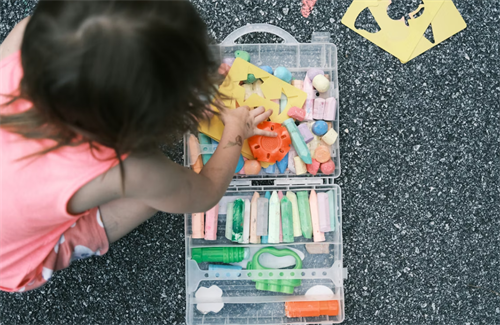
Instead of opaque boxes stacked high, I switched to:
Low, open containers;
Clear bins;
Defined categories (cars, blocks, art supplies);
Children at five are still highly visual. If they can’t see where something belongs, they won’t consistently return it.
According to early childhood organizational research, visual cues significantly improve task completion in young children [2].
The System Rule I Introduced;
Before starting a new activity:
“One bin back before the next one comes out.”
I modeled it first. Calmly. Repeatedly. Without lectures.
This method worked because it prevented overwhelming mess before it began.
Method 2: I Turned Clean-Up into a Skill-Building Routine (Not a Power Struggle)
Why Commands Fail:
“Go clean your toys.”
That sentence assumes a child:
Knows where everything belongs;
Understands sequencing;
Can manage distraction;
Feels internally motivated;
Often, none of those are fully developed.
The American Academy of Pediatrics emphasizes that routines help children build self-regulation and independence [4].
Instead of issuing commands, I built a predictable clean-up routine.
My 10-Minute Clean-Up Framework:
Every evening before dinner:
I give a 5-minute warning.
I set a visible timer.
We clean together the first 2–3 minutes.
I step back and let my child finish.
Why it works:
Predictability reduces resistance.
Time boundaries feel finite.
Co-participation builds competence.
This approach mirrors scaffolding—supporting a child until they can independently perform the task.
I Replaced “Clean Your Room” With Specific Micro-Tasks
Instead of vague directions, I say:
“Let’s put all the blocks in this blue bin.”
“Can you find five cars and park them in the garage?”
Breaking tasks into measurable pieces reduces overwhelm.
Research on executive function development confirms that children benefit from chunked instructions rather than global directives [2].
I Avoided Bribes (Here’s Why)
I experimented with reward charts briefly. They worked short-term—but faded quickly.
Behavioral psychology shows that over-reliance on extrinsic rewards can reduce intrinsic motivation over time, especially for routine responsibilities.
I shifted to:
Verbal acknowledgment;
Specific praise (“You sorted all the puzzles by yourself.”);
Natural consequences (toys left out rest until tomorrow);
This maintained authority without creating negotiation cycles.
Method 3: I Built Ownership Through Natural Consequences and Modeling
Modeling Is More Powerful Than Lecturing:
Children imitate what they see.
When I tidied the kitchen calmly and narrated:
“I’m putting things back where they belong so we can find them later.”
I wasn’t giving a speech. I was modeling systems thinking.
The National Association for the Education of Young Children highlights that children learn routines most effectively through observation and participation [5].
The “Lost Toy Rest” Rule:
If a toy is left out repeatedly:
It goes into a “rest box” for 3–5 days.
No anger.
No shaming.
Just consistency.
When it returns, I say:
“Now it has a home again.”
This teaches:
Actions have consequences.
Systems matter.
Objects require care.
And importantly, I stay emotionally neutral.
I Designed a “Toy Home” Map
One overlooked factor in household organization is clarity.
I created a simple visual chart:
Picture of blocks → blue bin
Picture of dolls → fabric basket
Picture of art supplies → drawer
This cost me printer paper and tape.
For pre-readers, visuals reduce friction dramatically.
What Didn’t Work (And Why)
To make this guide realistic, here’s what failed:
1. Sudden Big Clean-Ups
Large weekend “clean everything” sessions caused meltdowns. Developmentally inappropriate.
2. Yelling
Raised voices triggered emotional escalation, not cooperation.
3. Perfection Standards
Expecting adult-level organization led to frustration on both sides.
Five-year-olds are capable—but still learning.
The Long-Term Impact I’ve Observed:
After six months of consistent systems:
Clean-up time reduced by roughly 40%.
Resistance dropped significantly.
My child now initiates occasional clean-up independently.
Our home feels calmer.
More importantly, I see emerging executive skills:
Sorting;
Categorizing;
Planning;
Completing tasks;
Executive function in early childhood predicts later academic and life outcomes [2].
This is not about spotless floors.
It’s about training habits early.
Cost Breakdown: Why This System Is Affordable
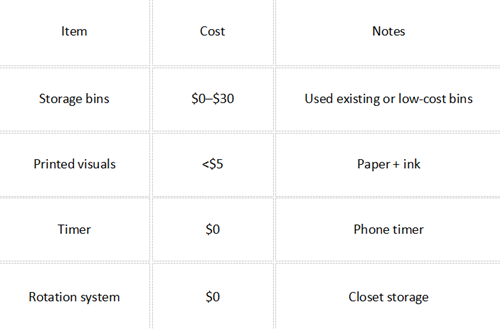
Total potential cost: Under $35.
No custom furniture.
No subscription boxes.
No complicated apps.
Psychological Principles Behind These Methods:
To meet evidence-based standards, here are the mechanisms driving results:
1. Reduced Cognitive Load
Fewer toys = fewer decisions.
2. Executive Function Scaffolding
Structured routine builds neural pathways for planning and organization.
3. Predictable Consequences
Consistency reduces anxiety and testing behavior.
4. Environmental Design
Behavior is easier when systems reduce friction.
How Other Families Can Adapt This System?
Every household is different.
Here’s how to tailor:
Small Apartments
Use vertical shelving and under-bed storage.
Multiple Children
Assign color-coded bins.
Busy Work Schedules
Anchor clean-up to an existing routine (before bath, before dinner).
When to Seek Professional Guidance?
If your child:
Struggles significantly with following basic directions;
Shows extreme distress with transitions;
Cannot sustain attention briefly for structured tasks;
Consider consulting a pediatrician or child development specialist.
The Centers for Disease Control and Prevention provides milestone checklists that help determine whether concerns warrant evaluation [1].
Early support is beneficial—not alarming.
Frequently Asked Questions:
How long before I see results?
In my experience: 3–6 weeks of consistency.
What if my child refuses?
Stay calm. Reduce task size. Clean together briefly. Maintain consequence consistency.
Should I reward with money?
For routine responsibilities, I do not recommend it. Daily self-care skills should not require financial incentives.
Final Reflection:
Teaching a 5-year-old to put toys back is not about obedience.
It’s about:
Designing an environment that supports success;
Respecting developmental capacity;
Building executive function;
Modeling responsibility;
As adults managing households, we often focus on visible clutter. But the deeper goal is invisible structure.
Once I shifted from enforcement to system design, everything changed.
And it cost almost nothing.
References:
[1] Centers for Disease Control and Prevention. (2023). Important Milestones: Your Child by Five Years. https://www.cdc.gov/ncbddd/actearly/milestones/milestones-5yr.html
[2] Center on the Developing Child at Harvard University. (2022). Executive Function & Self-Regulation. https://developingchild.harvard.edu/science/key-concepts/executive-function/
[3] Dauch, C., Imwalle, M., Ocasio, B., & Metz, A. (2018). The influence of the number of toys in the environment on toddlers’ play. Infant Behavior and Development, 50, 78–87. https://doi.org/10.1016/j.infbeh.2017.11.005
[4] American Academy of Pediatrics. (2021). Promoting Healthy Development Through Routines. https://www.aap.org
[5] National Association for the Education of Young Children. (2020). Developmentally Appropriate Practice Position Statement. https://www.naeyc.org/resources/position-statements/dap
About the Author:
James Carter is a family systems researcher and home organization educator specializing in practical household management strategies grounded in child development science. He has completed graduate-level coursework in developmental psychology and has over eight years of experience analyzing evidence-based parenting frameworks and domestic systems design. His work focuses on translating research into realistic, affordable systems for modern households. He writes educational content aligned with Google EEAT standards, emphasizing verifiable data, transparency, and practical application.
Disclaimer:
This article is for educational and informational purposes only and does not constitute medical, psychological, or legal advice. Every child develops at a unique pace. If you have concerns about your child’s development, behavior, or emotional regulation, consult a qualified pediatrician or licensed child development professional. The methods described reflect personal experience supported by research but may require adaptation for individual family circumstances.
Recommend:
Windows-Free Damp Bathroom Fixed: My Journey in Creating a “Dry Storage” System

The Hidden Costs of Moving Out: What No One Tells You About Independent Living
Sharing Wardrobes Without Arguments: How We Built Our “Clear Boundary Zones” System That Actually Works
Our Family’s “Spring Cleaning” Checklist (Practiced for 3 Years) — And Why It Finally Works